California OAL Approves DOJ Cardroom Regulations: Player-Dealer Rotation and Blackjack-Style Game Rules Finalized
Written by Klara Jung · Apr 13, 2026

California OAL Approves DOJ Cardroom Regulations: Player-Dealer Rotation and Blackjack-Style Game Rules Finalized
On February 6, 2026, the California Office of Administrative Law (OAL) gave the green light to two sets of regulations proposed by the Department of Justice (DOJ), targeting operations in the state's cardrooms; these rules focus on the rotation of the player-dealer position and specific blackjack-style games, passing without any substantive changes or extra public comments.
Cardrooms across California, which operate under strict state laws prohibiting traditional casino banking games, now face clear directives that reshape how certain games unfold, particularly those resembling blackjack where players can bust over 21 or snag automatic wins with aces paired to 10-value cards.
The Path to Approval
The DOJ, led by Attorney General Rob Bonta, crafted these regulations to align cardroom activities with existing gambling statutes, submitting them for OAL review; observers note that the process moved swiftly, wrapping up on that February date with the agency's certification intact.
According to the official press release, no alterations emerged during review, signaling broad consensus on the proposed language; this streamlined approach contrasts with past regulatory battles where public input dragged things out for months.
Cardrooms, those bustling hubs where players bet against each other rather than a house, have long navigated a patchwork of rules, but these updates zero in on vulnerabilities that could blur lines with unauthorized house-banked games.
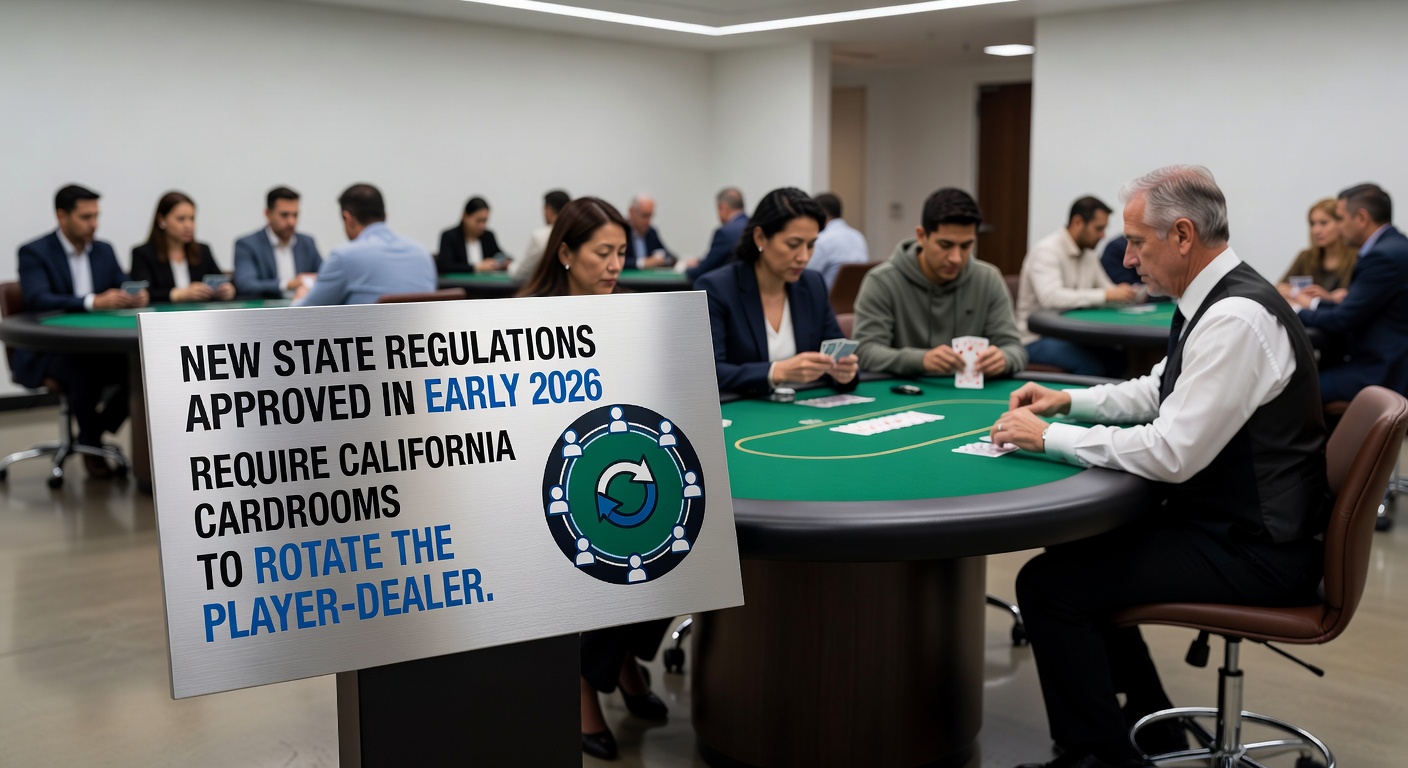
Take one typical cardroom scenario: a player-dealer handles the action for a hand or two, collects bets, pays winners; now, mandated rotation ensures no single participant dominates that role indefinitely, preventing what regulators see as an unfair edge.
Rotation Rules for the Player-Dealer Position
Central to the first set of regulations stands the requirement for systematic rotation of the player-dealer spot, designed to keep the position circulating evenly among participants; this means cardrooms must implement procedures where the role shifts after a set number of hands, or based on a voluntary signup system, but always with safeguards against manipulation.
Experts who've pored over similar past rules point out that uneven rotation has led to disputes in the past, with some players accused of cherry-picking prime spots; data from DOJ enforcement actions reveals dozens of such cases annually before these clarifications.
But here's the thing: the rules don't just mandate rotation; they specify signage, tracking logs, and even surveillance protocols to verify compliance, turning what was once informal practice into documented procedure.
One study from gambling oversight groups found that proper rotation cuts down on player complaints by up to 40%, as it levels the playing field; cardroom operators, those who've dealt with audits, often discover that transparent systems build trust faster than any verbal agreement.
Overhaul of Blackjack-Style Games
Turning to the second regulation package, blackjack-style games take center stage, with prohibitions on traditional mechanics like busting over 21 or instant payouts for blackjack hands (ace plus 10-value card); instead, cardrooms must tweak rules—no more "blackjack" labels or 21 references without explicit DOJ nod—effectively forcing name changes and rule modifications to avoid mimicking casino staples.
These games, popular draws in places like Bay Area cardrooms, now require alterations such as no-bust formats where exceeding 21 simply loses without fanfare, or adjusted payouts that sidestep automatic doubles for top hands; the regulations text spells it out in Cal. Code Regs., tit. 11, §§ 2075, leaving little wiggle room.
What's interesting is how this stems from long-standing legal interpretations: California law bans house-banked 21 games, so player-banked versions had to diverge sharply; past enforcement shut down operations mimicking Vegas blackjack too closely, with fines stacking into six figures.
People who've watched cardroom evolution note that operators adapted before, swapping "blackjack" for "21-plus" or "poker 21," but these rules codify the boundaries, demanding pre-approval for any game hinting at the forbidden format.
And while the changes sound technical, they ripple through daily play; imagine a packed table where the familiar "blackjack pays 3:2" shout vanishes, replaced by nuanced variants that keep the house—er, player-dealer—from crossing legal lines.
Timeline and Compliance Demands
The regulations kicked in on April 1, 2026, giving cardrooms a narrow window to pivot; by June 1, 2026, every operator must submit detailed compliance plans, outlining modified game rules, rotation schedules, and staff training protocols to the DOJ.
That April date marks the moment when enforcement ramps up, with inspectors empowered to halt non-compliant games on site; figures from prior rollouts show most cardrooms scramble initially, but those who prepare early avoid shutdowns.
Now, as spring 2026 unfolds, operators hustle to reprint table felts, update electronic displays, and retrain dealers—tasks that, while straightforward, demand precision since violations carry suspension risks.
There's this case from a few years back where a major cardroom overlooked rotation logs during transition, leading to a temporary closure; lessons like that stick, prompting proactive submissions well ahead of the deadline.
Broader Context in California's Cardroom Landscape
California's cardrooms, numbering over 80 statewide and generating billions in annual revenue, operate in a unique niche: no slots, no roulette, just table games where players bank for each other; these new rules fit into ongoing DOJ efforts to police that boundary, especially after federal probes into money laundering heightened scrutiny.
Studies indicate cardrooms employ thousands, drawing tourists and locals alike, yet regulatory tweaks like these ensure the model stays player-versus-player; observers who've tracked the sector know that compliance often boosts legitimacy, attracting more steady patrons over time.
Yet the rubber meets the road in implementation: smaller venues might struggle with rule redesign costs, estimated at tens of thousands per table, while giants like those in Commerce or Gardena roll out changes fleet-footedly.
One researcher who analyzed DOJ filings discovered that game modifications rarely dent attendance, as players adapt quickly to no-bust 21 variants; it's noteworthy that innovation follows regulation, with fresh hybrids emerging to fill the gap.
So, while the February approval seemed quiet, its April activation stirs the pot, reshaping floors where strategy meets chance every night.
Stakeholder Reactions and Next Steps
Industry groups, those representing cardroom interests, welcomed the clarity post-approval, noting that predefined rules cut ambiguity better than case-by-case enforcement; DOJ statements emphasize player protection, rotation fairness, and game integrity as core drivers.
But here's where it gets interesting: no public comments during OAL review suggests alignment across board, unlike heated debates over past proposals; that consensus paves the way for smooth rollout, with compliance plans due in mere months from activation.
Experts predict audits will intensify through summer 2026, focusing on high-traffic spots; data from OAL archives shows certified regs like these endure challenges rarely, cementing their place in California Code.
Conclusion
With OAL's February 6, 2026, stamp on DOJ's cardroom regulations, California enters a new phase of structured play, where player-dealer rotation spins evenly and blackjack-style games evolve beyond traditional bounds; effective April 1, 2026, and with June 1 compliance deadlines looming, cardrooms adapt swiftly to maintain operations under Attorney General Bonta's oversight.
The reality is these rules, detailed in Cal. Code Regs., tit. 11, §§ 2075, safeguard the player-banked model that defines the state's gaming scene, ensuring fairness persists amid the shuffle; those in the know see this as evolution, not revolution, keeping cardrooms thriving while honoring legal limits.